
San José Needs a Customer Service Mindset

When residents contact the City of San José, they should expect someone to take responsibility for helping them—not be sent from one department to another.
Last week, I encountered a frustrating example of this.
While biking along 3rd Street in downtown San José, I noticed a large dumpster completely obstructing the bike lane. This was a safety issue, forcing cyclists into traffic.
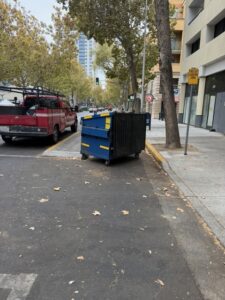
I reported the obstruction through the City’s 311 app, expecting the City to address the problem.
Instead, I received a response telling me to contact the Department of Transportation at Traffic.Safety@sanjoseca.gov.
So I did.
The Department of Transportation responded by telling me to report the problem through San José 311.
Seriously?
I had now contacted two different parts of the same city government, and each had directed me to the other. Neither had taken responsibility for resolving the issue.
From the City’s perspective, perhaps everyone followed the correct procedures. From my perspective, as a resident, this was simply terrible customer service.
Another Example: Trying to Build an ADU
Around the same time, a neighbor shared his experience trying to build an accessory dwelling unit (ADU) in Naglee Park.
San José has made increasing housing density a major policy objective. ADUs are supposed to be one of the easier ways to add housing to existing neighborhoods.
Yet my neighbor described a permitting and construction process that has become extraordinarily expensive and frustrating.
According to his account, Planning and Building imposed requirements that were not always consistent, and rather than coordinating with each other, they left him to resolve the differences.
He described long delays between inspections, changing interpretations of requirements, and unexpected expenses. A project originally expected to take six months has stretched to more than two years, with costs exceeding $500,000.
I can’t independently assess which technical requirements were justified. Building and fire safety are obviously important.
But that’s not the point.
Why should a resident have to coordinate the City’s departments to get a project approved?
Why shouldn’t Planning, Building, and Fire work together to provide clear, consistent requirements and resolve disagreements internally?
And if the City wants to encourage ADUs, shouldn’t it make the experience of building one as straightforward and predictable as possible?
Residents Are Customers of City Government
I think San José needs to embrace a fundamental principle: Residents are customers, and the City exists to serve them.
That doesn’t mean government should operate exactly like a private business. Government has responsibilities that businesses don’t, including enforcing laws, protecting public safety, and treating everyone fairly.
But none of those responsibilities excuses poor customer service.
When someone contacts the City with a problem, they shouldn’t need to understand its organizational chart. They shouldn’t need to know which department has jurisdiction, which email address to use, or how to reconcile conflicting instructions.
Those are internal responsibilities.
A customer-service mindset means that whoever receives a request takes responsibility for making sure it gets to the right place and that the resident receives a meaningful response.
It means departments collaborate with one another instead of sending residents back and forth.
And it means measuring success by whether the resident’s problem was resolved—not simply whether a ticket was closed or an email was answered.
What Would a Customer-Service Culture Look Like?
Imagine if my 311 report had resulted in a response like this:
Thank you for reporting the obstruction. We’ve forwarded your report to the appropriate team and will follow up on its resolution. You don’t need to do anything else.
That’s it. I wouldn’t care which department handled it. I would simply know that the City had taken responsibility.
Or imagine if someone applying for an ADU permit had a single point of contact responsible for coordinating Planning, Building, Fire, and other relevant departments.
If departments disagreed about a requirement, they would resolve that disagreement themselves and communicate a clear decision to the applicant.
This isn’t about eliminating regulations or compromising safety. It’s about delivering government services in a way that respects residents’ time, money, and effort.
Customer Service Starts With Leadership
Changing this requires more than a better website or a redesigned 311 app.
It requires a cultural shift, starting with City leadership.
Every department should understand that providing good customer service is a fundamental part of its mission.
The City should establish clear expectations around responsiveness, coordination, accountability, and resolution. And it should regularly measure residents’ experiences. Not just internal departmental performance.
Are residents getting their problems resolved? Are permit applicants receiving consistent information? How often are people transferred between departments? How long does it take to reach an actual resolution?
These are the kinds of questions that should matter to City management.
I recognize that San José has many dedicated public employees who work hard to serve our community. My criticism isn’t directed at individual employees. It’s about whether the organization empowers and expects them to deliver a good experience to the public.
One City, One Customer Experience
San José has ambitious goals: building more housing, improving transportation safety, creating vibrant neighborhoods, and making the city a better place to live.
Achieving those goals requires more than adopting good policies. It requires a city government capable of implementing them effectively.
A resident reporting a dangerous bike-lane obstruction shouldn’t get caught between 311 and Transportation.
A homeowner trying to build an ADU shouldn’t have to referee disagreements between City departments.
To residents, there is only one City of San José. We shouldn’t have to navigate its internal bureaucracy to receive the services we’re entitled to expect.
I recognize that the City is working to improve its services. My goal in sharing these experiences is to highlight where those efforts are still falling short. There’s clearly more work to be done before residents consistently experience the customer service they deserve.





When Ron Gonzales was mayor, we had a call center that routed all calls to the right department, it was not perfect but we received a much higher level of service than we experience now.