Shot Hole Borer: OUR TREES ARE AT RISK

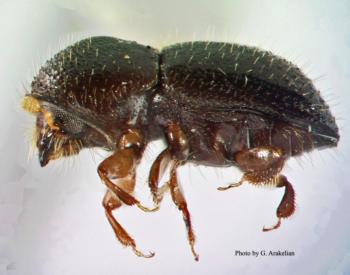
Our trees are at risk of infestation and dying from the Invasive Shothole Borer (ISHB), a small beetle that when boring into a tree, introduces a fungus that can cause branch dieback and eventually death to the entire tree. There are many trees that are susceptible to infestation, but of particular interest to our neighborhood are Sycamore/London Plane, Liquid Amber, Box Elder and maples.
The city is working to help control the spread of the ISHB, but your help is needed as well.
Check out the City of San Jose ISHB website to find the interactive map under the heading “What You Can Do”. The map shows all the affected street trees that have been identified, showing whether the infestation is low, medium or high. Street trees where no infestation was found are not on the map.
At this time the city plans to treat all “medium” infected street trees (50+ tiny holes producing staining) and to remove those street trees identified as “high” (150+) at their expense. Trees with a low infection are NOT going to be treated by the city, nor will they treat trees on your property.
If you have a street tree with a low infestation or suspect ones on your property might be infested, you need to monitor their condition. Because this may require professional assistance, it’s important to know that the assistance of an ISHB qualified arborist should be used. On the city’s website is a list of tree companies with arborists who are qualified to advise on the ISHB infestation.
There are fine ISHB qualified arborists who are not associated with tree companies, but not listed with the city. The advantage of these professionals is they provide advice only and therefore they are not going to sell you additional services you don’t need (for example fertilizing and deep watering) to deal with this problem.
The researchers have recommended that with a low infestation, watching for more symptoms (often referred to as monitoring) is the best thing to do as some trees recover on their own. If the number of sites, small holes accompanied with brown staining, increases to around 30, treatment at that point is generally thought best to be a trunk spray, or if the infestation seems to be significantly increasing, an injection. Soil drenches, another treatment, will not work on our street trees as it needs to be applied to the soil at the tree’s drip line, the perimeter directly beneath the outer edge of the tree’s branches. In all cases it’s not a DIY thing as the proper chemicals can be purchased by a only qualified professional. It’s a fairly expensive undertaking with costs between $300 and $800. We are looking at the possibility of getting a group rate for us, but the chemicals used are very expensive. We’ll keep you informed.
In addition, the debris from removal of branches and trunks must be chipped to 1” and removed to an appropriate composting place, NOT included in your green curbside waste. The beetles can survive in the cut material and if not disposed of properly will spread the infestation.
Soon we will be distributing a flyer to all NP addresses. If you want the most complete information about the Invasive Shothole Borers check out the UC IPM Pest Notes: Invasive Shothole Borers.pdf. This publication is from 2023, but is mostly up to date. As you know science can be fluid as more is learned, so updates are likely.
This is a serious problem and if left unchecked can decimate our tree canopy, devalue your property, increase summer heat and change the character of our neighborhood.
The Naglee Park Tree Stewards, a subgroup of the Beautification Committee.
For More Information, Visit: